The Last Gold Rush & Final Boundaries (1896-1912)


Routes to the Klondike

On August 16, 1896, an American prospector named George Carmack, his Tagish wife Kate Carmack, her brother Skookum Jim, and their nephew Dawson Charlie were travelling south of the Klondike River. Following a suggestion from Robert Henderson, a Canadian prospector, they began looking for gold on Bonanza Creek, then called Rabbit Creek, one of the Klondike's tributaries. It’s not clear who discovered the gold, George Carmack or Skookum Jim, but the group agreed to let George Carmack appear as the official discoverer because they feared that authorities would not recognize an Indigenous claimant.

In any event, gold was present along the river in huge quantities. Carmack measured out four claims (strips of ground that could later be legally mined by the owner) along the river including two for himself, (one as his normal claim, the second as a reward for having discovered the gold) and one each for Jim and Charlie. The claims were registered the next day at the police post at the mouth of the Fortymile River and news spread rapidly from there to other mining camps in the Yukon River valley.

By the end of August, all of Bonanza Creek had been claimed by miners. A prospector then advanced up into one of the creeks feeding into Bonanza, later to be named Eldorado Creek. He discovered new sources of gold there, which would prove to be even richer than those on Bonanza.  Claims began to be sold between miners and speculators for considerable sums.

Just before Christmas, word of the gold reached Circle City. Despite the winter, many prospectors immediately left for the Klondike by dog-sled, eager to reach the region before the best claims were taken. The outside world was still largely unaware of the news and, although Canadian officials had managed to send a message to their superiors in Ottawa about the finds and influx of prospectors, the government did not give it much attention. 

The winter prevented river traffic, and it was not until June 1897 that the first boats left the area, carrying the freshly mined gold and the full story of the discoveries.


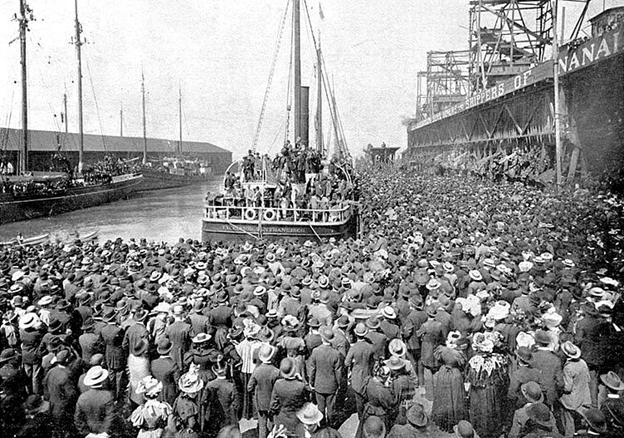
SS Excelsior leaving San Francisco for the Klondike


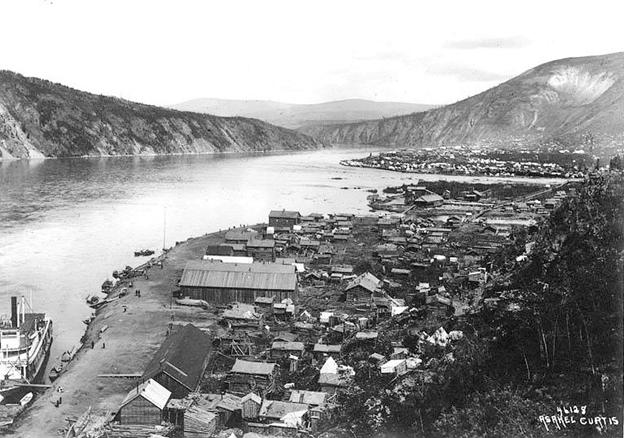
When news reached Seattle and San Francisco, a stampede ensued with an estimated 100,000 people trying to reach the Klondike goldfields, though only 30,000-40,000 eventually did. The town of Dawson City was founded at the confluence of the Klondike and Yukon rivers and grew from a population of 500 in 1896 to 30,000 by the summer of 1898. Once again prospectors ignored the First Nations people already living in the area and they were forcibly moved to a reserve.

The Chilkoot Pass


There were three principal routes to the Klondike, the All-Canadian Route, crossing swamps, river gorges and mountains which few took, the All-Water Route that followed the Yukon River from its delta in the Bering Sea to Dawson City but was only open when the river wasn’t frozen, and the more popular Skagway/Dyea Route that led over the Chilkoot Pass/White Pass and then down the Yukon River to Dawson City.

Dawson City

At the start of the gold rush the Canadian government introduced rules requiring anyone entering Yukon Territory to bring with them a year's supply of food. Typically, this weighed around 1,150 pounds and by the time camping equipment, tools and other essentials were included, a typical traveller was transporting as much as 2,000 pounds in weight. All of this had to be transported from the dock at Skagway or Dyea up and over the Chilkoot or White Pass in multiple trips until the prospector made it to the Yukon border and from there could connect to the head of the Yukon River.


It was an arduous process to get to Dawson City and then the work really began as miners first had to clear the ground of vegetation, then dig through the permafrost to get to the bedrock where the gold could be found after the dirt and gravel were sluiced and panned with water to separate the heavier gold from the gravel. In the end very few became rich and most who did find gold lost their fortunes in the following years. By 1899 it was mostly over but in the intervening years Dawson City became legendary for its 24 hour saloons, brothels, dance hall girls, and champagne drinking.  


Map of the goldfields


On June 13th, 1898 the territory of Yukon was created from the North-West Territories. Ironically it was the gold rush that uncovered the skeletal remains of wooly mammoths, scimitar cats, and other creatures from Beringia, the ancient entrance point to North America, that until now had lay hidden and preserved under the permafrost. 


On September 1st 1905 the Provinces of Alberta and Saskatchewan were created from the North-West Territories.

On May 15th, 1912 the Provinces of Manitoba, Ontario, and Quebec were expanded with territory from the North-West Territories. The borders of Canada and its Provinces would remain unchanged for nearly 100 years until the remaining Northwest Territories were divided in half and the Territory of Nunavut was created on April 1st 1999.

By the end of the 19th century Canada had secured all its external and internal borders without having to fire a single shot. Independence from Britain was bloodless, unlike the American independence or that of so many other former colonies. While all the First Nations people in North America ended up losing their land in the process, at least in Canada it was done with guile and duplicity as opposed to the outright slaughter that was carried out by the United States government.

Settling The Land (1872-1914)


Following the successful signing of the first two numbered treaties the government, in 1872, passed the Dominion Lands Act to encourage the settlement of the Canadian prairies. In order to settle the area, Canada invited mass emigration by European and American pioneers and settlers from eastern Canada. It echoed the American homestead system by offering ownership of 160 acres of land free (except for a small $10.00 registration fee) to any man over 18 or any woman heading a household. They did not need to be British subjects, but they had to live on the plot and improve it. Within 3 years at least 40 acres had to be cultivated and a permanent dwelling built. An additional 160 acres could also be purchased for an another $10.00 fee. First Nations people however were not permitted to buy the land.

The Canadian government in collaboration with the CPR (which had been given 25 million acres of land on either side of the railway) launched advertising campaigns in many countries to attract potential immigrants to Canada. There was money to be made transporting eager young men and women and their belongings to their new homes in the West and the CPR was also in the business of selling land.

And come they did. Between 1896 and 1914, more than two million settlers from Europe and the United States poured into the prairies in the greatest wave of immigration in Canadian history. By 1901, of the more than five million people in Canada, almost 700,000 (12 percent) were immigrants (not born in Canada).

From 1896-1911 Canada had the world's fastest-growing economy. Immigration from Eastern Europe and the Eastern parts of the former Austro-Hungarian empire brought many old-world farmers to settle the West and, despite their lack of knowledge of the English language, many adapted quickly to the farming environment which was somewhat similar to their original homelands.


On July 1st 1873 Prince Edward Island joined Confederation and the North-West Mounted Police (later changed to the R.C.M.P.) was established to maintain order in the North-West Territories. This was following the Cypress Hills massacre where a group of drunken American buffalo and wolf hunters attacked a camp of Assiniboine, who they thought had stolen their horses. The resulting massacre left over 30 men, women, and children dead, not counting those injured and raped, and the country outraged. A realization that law and order needed to be maintained along with stricter control over the border, otherwise the American military might invade and not leave, led to its formation and gave the NWMP military, police, and judicial functions.


On September 1st, 1880 the British Arctic Islands were transferred to Canada and added to the North-West Territories.


Since 1871, when British Columbia was promised a railway connecting it to the rest of Canada, there was fierce competition for the contract to build the railway that ended up being mired in politics and corruption. It took another 10 years but, by 1881, the Canadian Pacific Railway (CPR) was incorporated and the contract awarded.

The difficulties of construction and demand for early completion of the rail line ensured generous provisions to the company, including $25 million in cash, 25 million acres of land in a belt along the railway, the cost of surveys totalling $37 million, and a monopoly over transportation south to the United States for 20 years. 

The government also transferred to the new company those sections of the railway it had constructed under government ownership, on which it had already spent at least $25 million, and exempted the railway from property taxes for 20 years. Due to the high cost of construction, the CPR would later receive an additional $22.5 million in loans under the Railway Relief Act of 1884.

The C.P.R. began its westward expansion from Bonfield, Ontario in 1881 where the first spike was driven into a sunken railway tie. Bonfield was the point where the Canada Central Railway extension ended.

Under the management of  W.C. Van Horne, construction rapidly progressed across the plains. Originally the railway was to follow a route through the Yellowhead Pass, but a more southerly route through Kicking Horse Pass was eventually decided upon. Construction through the rock and muskeg of the Canadian Shield almost equalled in difficulty the engineering feats required to build a route through the mountains of British Columbia.


The difficulty in obtaining an adequate work force in British Columbia led to the controversial employment of thousands of Chinese workers. Upwards of 15,000 Chinese labourers helped to build the Canadian Pacific Railway. Working in harsh conditions for little pay ($1.00 per day which was half the rate paid to white workers) these workers suffered greatly and its estimated that at least 600 died working on the railway. The employment of Chinese workers caused controversy, particularly in British Columbia, where politicians worried about the potential economic and cultural impact of these workers.

When the CPR was finished in 1885, the government passed the Chinese Immigration Act, which established a head tax for anyone of Chinese origin entering the country. Starting at $50 it rose to $100 and eventually $500 by 1903. The government also passed the Electoral Franchise Act, which excluded “persons of Mongolian or Chinese race” from voting.

In four years the line through to the Pacific coast was completed on November 7, 1885 with the driving of the "Last Spike" at Craigellachie in Eagle Pass, British Columbia. The first through passenger train left Montreal on June 28, 1886 and arrived at Port Moody, British Columbia, on July 4th.


Louis Riel

While there were no full-scale Indian wars (such as those fought in the United States) as Canada expanded into First Nations territory in the Prairies, there was the armed 1885 North-West rebellion. The North-West Rebellion was a rebellion by the Metis people under Louis Riel and an associated uprising by First Nations Cree and Assiniboine of the District of Saskatchewan against the Canadian government. Many Métis who had settled in Saskatchewan felt that Canada was not protecting their rights, their land, and their survival as a distinct people.

Riel had been invited to lead the movement of protest and he turned it into a military action with a heavily religious tone. While he alienated many he had the allegiance of 200 armed Metis and a smaller number of other Indigenous warriors who confronted 900 Canadian militia and some armed local residents. About 91 people would die in the fighting that occurred that spring before the rebellion's collapse.

Despite some notable early victories at Duck Lake, Fish Creek and Cut Knife, the rebellion was quashed when overwhelming government forces and a critical shortage of supplies brought about the Métis' defeat in the four-day Battle of Batoche. The remaining Aboriginal allies scattered. Several chiefs were captured including Big Bear and Poundmaker, who had participated in raids on Battleford and Frog Lake to obtain food, and were sentenced to serve prison time. Eight men were hanged in Canada's largest mass hanging, for murders deemed to be performed outside the military conflict.

Riel was captured, put on trial, and convicted of treason. Despite many pleas across Canada for clemency, he was hanged while his general, Gabriel Dumont who had escaped to the U.S. was eventually pardoned. As a result, Riel became a heroic martyr to Francophone Canada. The rebellion's suppression contributed to the Prairie Provinces being controlled by English Protestants, and the marginalization of French speaking Catholics who ended up living in shantytowns and on undesirable land such as road allowances.


With the annihilation of the buffalo, First Nations people living in the Prairies were encouraged by the government to become farmers. After the signing of the Plains treaties families began moving on to the land that had been allotted to them which, according to the text of the treaty, was 640 acres (one square mile) of land for each family of five. This was in keeping with the average size of farms at the time. The treaties also stipulated that each family that cultivated the soil would receive seeds and tools and farming implements, the specific types and number of which depended on the specific treaty. 

For example, Treaty 6 supplied “four hoes for every family, two spades per family, one plough for every three families, one harrow for every three families, two scythes and one whetstone, and two hay forks, for every family, and one grindstone and one auger for each Band.” 

Indian agents and farm instructors also worked with the First Nations to teach them how to farm, although raising crops such as corn or rice was not new to some cultures. In Saskatchewan in particular, some of the First Nation farmers were very successful, and grew crops and produce as good or better as that produced by the settlers. They also formed collectives to share the costs of new equipment and labour. 

Aboriginal farming success in the 1880’s soon led to settler animosity over what they viewed as unfair competition and they complained to the Indian Commissioner Hayter Reed. Completely ignoring the fact that providing seeds, farming implements, and supplies in case of crop failure were all part of the treaty settlement First Nations were to receive in exchange for all the land they had surrendered, the settlers demanded change. They had a sympathetic ear with Hayter Reed who felt that the Indigenous peoples should only produce enough for themselves to be self-sufficient, and not be competing with outside farmers. This of course was completely contrary to the government’s original intent. 

Nonetheless in 1889 the government brought in the Peasant Farm Policy for First Nations people. Built on the racist belief that Indigenous people were at an earlier stage of evolution than white people and had to gradually evolve into modern farmers, the Act severely restricted the types of tools First Nations could use, how much they could grow, and what they were allowed to sell. Reed implemented three policy initiatives that would change the lives of First Nations people and effectively sabotage most of the agricultural practices that had produced successful Aboriginal farmers. These were; 

1.   Severality – Reserve farmland was now divided into 40-acre plots and no one farmer could own more than 160 acres.  The intention was to promote "individualism", directly undermining successful collective efforts.  Also, any "left over" land would be surrendered and made available for sale to non-natives.

2.   Peasant farming – Peasant farming refers to the use of only basic tools to grow crops and raise animals. It involves seeding and doing other tasks by hand, without the help of machines. The purpose was to reduce output to subsistence levels, essentially just enough to support a single family.  Thus, expensive large-scale machinery would be unnecessary, and aboriginal farmers would become "more self-sufficient" by using peasant-methods of production instead of the more advanced techniques they’d been using.

3.   The pass and permit system which required First Nations to obtain a permit from an Indian agent before they could legally sell their products off-reserve and a pass if they wanted to leave the reserve for any reason. Local businesses were prohibited from purchasing products from any First Nations person who did not have a permit and if caught off reserve without a pass an Indigenous person could be arrested.

With farms too small to support any profitable production and farmers unable to purchase or use machinery or work collectively, as well as being forbidden to sell their crops, these policies soon put most of the Indigenous farmers out of business and their unused land ended up being sold to settlers by the Indian agent who could now claim the farmland wasn’t being used properly. By the time the government abandoned the Peasant Farm Policy in 1897 Aboriginal farming was severely damaged. Having already signed away all their land in exchange for reserves they now lost part of these as well to the settlers who completely took over the Prairies.

The Indian Act (1876-present day)


With the first seven of the numbered treaties signed, and First Nations living on reserves, the government could now open up former First Nation territory to settlers. However, it still had a responsibility for the welfare of First Nations people and its aim now was to assimilate the Indigenous population which would eventually reduce government responsibility and cost. To do this, the government in 1876 brought in the Indian Act.

The Indian Act was an attempt to codify rights promised to Indigenous peoples in the Royal Proclamation of 1763 while at the same time enforcing Euro-Canadian standards of "civilization". The purpose of the act, as stated by its drafters, was to administer Indian affairs in such a way that Indian people would feel compelled to renounce their Indian status and join Canadian civilization as full members, a process called enfranchisement. 

Indigenous people with the franchise became official citizens of Canada, were allowed to vote for representatives, were expected to pay taxes, and lived "off-reserve". By contrast, groups of people who lived on a reserve were subject to a different set of rights and obligations. In other words, “enfranchisement” meant the relinquishing of Indian status to become a Canadian citizen.

The Indian Act under-mined Indigenous peoples’ identity, sovereignty, and nationhood. Indigenous peoples were classified as Indians and were seen as children or wards of the state with little autonomy or control of their own affairs, and were subject to a wide array of regulations.

In order to become a Canadian citizen bearing all rights and privileges, an Indian person had to meet one of two sets of the criteria. Under the first set, one had to be literate in English or French, be debt free, and have managed one’s land as property (through farming) for at least three years. Never mind these criteria made citizenship a lofty goal for most people who resided in Canada at the time.

Under the second set, one could become a citizen upon entering a profession as a lawyer, teacher, minister, or doctor. The enfranchisement program was unpopular, and very few Indigenous people pursued it.

To further assimilate the Indigenous populations, the Indian Act also abolished traditional forms of governance and inserted laws that brought local government under state control. Leadership roles of women, hereditary chiefs, and elders were replaced with a patriarchal, male-only elective system, largely under the control of the local Indian Agent. Leadership positions were simplified and categorized into “chiefs” and “band councillors”.

All their activities were overseen and directed by the Crown, and leaders could be removed from their posts at any time, for any reason. Band government effectively lost all of their law-making capacity, and the Department of Indian Affairs eventually gained full control of Indian resources, land, and finances. The Indian Act also defined who was considered an Indian under the law. 

It stated that an Indian was "any male person of Indian blood reputed to belong to a particular band." Indian status also applied to "any child of such person" and to "any woman who is or was lawfully married to such person." A person lost status if they graduated from university, or became a minister, doctor, or lawyer.

The provisions regarding a woman’s status were particularly extreme. Women with status lost their rights if they married a non-status person. A woman’s status rights flowed entirely through her husband. A non-status woman who married a man with status would gain status herself.  A status woman who married a status man had her band membership tied to his so she was no longer a member of her own band, and she lost her status entirely if she was widowed or abandoned by her husband. 

The assimilation goal of the Indian Act was to bring all people together under one form of law and one way of life. In 1884, the Indian Act was amended to ban ceremonies such as the Potlatch and the Sun Dance. The word potlatch itself means “to give” and a potlatch involves gift giving and feasting that can last for weeks. They are held at special occasions such as naming ceremonies, change of leadership, births, and deaths. The cultural event of the potlatch is significant in that it upholds the legal traditions of the Northwest Coastal people with the redistribution of wealth, refinement of oral histories, and affirmation of territorial boundaries. The more one would give, the more honour and respect one would earn. 

Since these customs reject the Western value of private property ownership and individualism, potlatches were viewed as a major barrier to assimilation. Because Indigenous peoples relied heavily on oral history as a means of cultural preservation, banning of these celebrations also resulted in a major breakdown in the ability of older generations to share important stories about laws and traditions with younger generations. 

Subsequent amendments required First Nations children to attend industrial or residential schools (1894 and 1920). In 1927, the Act made it illegal for First Nations peoples and communities to hire lawyers or bring about land claims against the government without the government’s consent. During the late 19th and early 20th centuries, the Indian Act was used to support the illegal pass system (which restricted the movement of First Nations peoples off reserves) and the permit system which regulated the sale of goods off reserves.

It wasn’t until March 31 1960 the Canada Elections Act was repealed in order to grant the federal vote to Status Indians and in 1985 the discriminatory rules around women’s status were removed.


Perhaps the most destructive of all government Indian Act policies, with regards to Indigenous peoples, was the setting up of the Residential School system. The Indian residential school system was a network of boarding schools for Indigenous peoples. Attendance was mandatory. The network was funded by the Canadian government's Department of Indian Affairs and administered by Christian churches.


The school system was created to isolate Indigenous children from the influence of their own native culture and language in order to assimilate them into the dominant Canadian culture, and to “kill the Indian in the child”. Over the course of the system's more than hundred-year existence, around 150,000 children were placed in 130 residential schools nationally.

Under Prime Minister John A. Macdonald, the government adopted the residential industrial school system of the United States, a partnership between the government and various church organizations. An amendment to the Indian Act in 1894, under Prime Minister Mackenzie Bowell, made attendance at day schools, industrial schools, or residential schools compulsory for all First Nations children. Due to the remote nature of many communities and lack of schools, residential schools were the only way for many families to comply and children were often forcibly removed from their homes by the R.C.M.P.

The schools were intentionally located at substantial distances from Indigenous communities to minimize contact between families and their children. Indian Commissioner Hayter Reed argued for schools at greater distances to reduce family visits, which he thought counteracted efforts to assimilate Indigenous children. Parental visits were further restricted by the use of a pass system designed to confine Indigenous peoples to reserves.


The residential school system harmed Indigenous children significantly by removing them from their families, depriving them of their ancestral languages, and exposing many of them to physical and sexual abuse. Disconnected from their families and culture and forced to speak English or French, students who attended the residential school system often graduated being unable to fit into their communities but remaining subject to racist attitudes in mainstream Canadian society.

Students in the residential school system were faced with a multitude of abuses by teachers and administrators, including sexual and physical assault. They suffered from malnourishment and harsh discipline that would not have been tolerated in any other Canadian school system. Corporal punishment was often justified by a belief that it was the only way to save souls or punish and deter runaways, whose injuries or death sustained in their efforts to return home would become the legal responsibility of the school. 

Overcrowding, poor sanitation, inadequate heating, and a lack of medical care led to high rates of influenza and tuberculosis. Federal policies that tied funding to enrollment numbers led to sick children being enrolled to boost numbers, thus introducing and spreading disease. The problem of unhealthy children was further exacerbated by the conditions of the schools themselves with overcrowding, poor ventilation, poor water quality and inadequate sewage systems.

Until the late 1950s, when the federal government shifted to a day school integration model, residential schools were severely underfunded and often relied on the forced labour of their students to maintain their facilities, although it was presented as training for artisanal skills. The work was arduous, and severely compromised the academic and social development of the students. During this period, Canadian government scientists also performed nutritional tests on students and kept some students undernourished as the control sample.

The system ultimately proved successful in disrupting the transmission of Indigenous practices and beliefs across generations. The legacy of the system has been linked to an increased prevalence of post-traumatic stress, alcoholism, substance abuse, suicide, and intergenerational trauma which persists within Indigenous communities to this day. It was bad enough the federal government was racist and completely distorted its fiduciary responsibilities, but that the various Christian churches would be complicit in such a gross violation of their core beliefs simply illustrates the hypocrisy of organized religion.

Trick Or Treaties From Sea To Shining Sea (1850-1921)


After Confederation, the newly formed Dominion of Canada looked to expand its borders from sea to sea. Even though the government had acquired the former Rupert’s Land they failed to have full control and use of the land as this transfer from Britain only provided sovereignty over the area. Title had reverted to the First Nations living there.

One of the conditions in order to ensure British Columbia would join Confederation at the time was the construction of the Canadian Pacific Railway (CPR) in order to connect it to the rest of the nation. This major infrastructure project would have to go through the interior of the newly acquired land which was all First Nation territory.

Canadian law, as set out in the Royal Proclamation, recognized that the First Nations who inhabited these lands prior to European contact had title to the land. In order to satisfy British Columbia's request and the growing need for land by eastern settlers and new immigrants, land transfer treaties would have to be signed with the First Nations people.

The Royal Proclamation occurred in 1763, and is considered to be the foundation of treaty-making in Canada. The Royal Proclamation stated that the only authoritative government that was able to purchase land from First Nations people was the British Crown. One of the stipulations of this agreement was that First Nations people were to be informed and attend a public assembly regarding the sale of their lands. 

When the 1867 British North America Act was enacted, a division of power was established between the Dominion of Canada government and its provinces that separated First Nation people and settlers. The federal government retained responsibility for providing health care, education, property rights and creating other laws that would affect the First Nations people, and the Provinces were responsible for everyone else. With the new federal government now replacing the British Crown as the leading authority and responsible for handling First Nations land transfers, they had a fiduciary duty to act in the First Nations best interests and to uphold the honour of the Crown, neither of which were adhered to. 

Both the Royal Proclamation and the British North America Act had a direct impact on the negotiations between First Nations and the federal government. They set the stage for future negotiations that would occur, including the Numbered Treaties that would begin in 1871 with Treaty 1.

The Numbered Treaties are a series of eleven treaties signed between the First Nations and Canada from 1871 to 1921. These treaty agreements were created to allow the Government of Canada to pursue settlement and resource extraction in the affected regions, which include modern-day Alberta, Saskatchewan, Manitoba, and parts of Ontario, B.C. and the Northwest Territories.

These treaties came in two waves; Numbers 1 through 7 from 1871 to 1877 and Numbers 8 through 11 from 1899 to 1921. In the first wave, the treaties were key to advancing European settlement across the Prairie regions as well as the development of the CPR. In the second wave, resource extraction was the main motive for government officials.

In these treaties, the First Nations were coerced and tricked into giving up aboriginal title to vast amounts of land, in exchange for reserves for their exclusive use and various promises of schools, food, and farming assistance as well as other entitlements such as hunting and fishing rights. The First Nations people couldn’t read the documents that were prepared and were relying instead on the oral agreements made at the negotiating table, (as long as the sun shines, the grass grows and the rivers flow) which would later lead to contention and discord.

The Indigenous understanding of the spirit and intent of the Numbered treaties was a nation-to-nation agreement, similar to the spirit of the original Peace and Friendship Treaties signed on the East Coast prior to 1779 where there was no surrender of rights to the lands and resources they had traditionally used and occupied.

However, the Government of Canada modelled the Numbered Treaties on the agreements made earlier by the Upper Canada Land Surrenders (1764-1862) and the Robinson and Douglas treaties whereby Indigenous signatories relinquished any claim to the lands specified in the treaties in exchange for a payment in goods, continued occupation of reserved lands, annuities, and the right to hunt and fish on Crown lands.

The Douglas treaties (1850-1854) were for small parcels of land to set up HBC settlements on Vancouver Island whereas the Robinson treaties (1850) were for vast swaths of land around Lakes Huron and Superior so they could be exploited for mining. The Robinson treaties also provided for a share in the wealth that would be gained by exploiting the land but, like so many clauses in all of the subsequent treaties, this was never lived up to.

The treaties also included clauses for schools and/or teachers to educate Indigenous children on reserve, and a provision for agricultural implements, seeds, and training to ensure the transition from a mobile to a sedentary life. The intent was to encourage all Indigenous signatories of the treaties to settle on reserve lands, build permanent communities, adopt agriculture, and permit the state to educate their children. Unfortunately it was a road to ruin paved with good intentions as one event after another subsequently upended what could only be termed a utopian fantasy.

For Indigenous signatories, these agreements had a stronger emphasis on shared usage, rights, and responsibility for the lands being ceded, rather than a complete surrender of land. For the state, these treaties were considered a massive land surrender, bringing Indigenous peoples under the jurisdiction and law of the new Dominion.

When the Colony of British Columbia joined Confederation in 1871 it did not recognize Indigenous title so it felt there was no need for treaties and, other than the Douglas Treaties and Treaty 8 signed by the Federal government to resolve problems related to the Klondike Gold Rush, treaties were not signed with any First Nations for the rest of British Columbia. With most of B.C. now considered unceded land, this was clearly both a mistake and a short sighted strategy. 

With Treaties 1-7, there was some resistance from members of the First Nations to the treaty process and a growing anxiety that it would allow a flood of settlers, but many also saw it as a way to secure much needed assistance. The First Nations at this time were suffering from disease, famine, and conflict due to the changing dynamics of the west

First Nations people were being decimated by disease, specifically smallpox and tuberculosis, which had catastrophic ramifications for several groups. They also began to suffer from famine due to the near extinction of the buffalo. They were eager to receive food aid and other assistance from the government, which they believed would be offered following the implementation of treaties.

Some First Nation groups also sought to ensure some form of education would be provided to them through the implementation of the treaties. Education was crucial to the First Nations because their cultural way of life was rapidly diminishing. They believed that the promise of education would not only help curb the loss of culture but also ensure their children's future success in a newly developed West. They were to be sadly disappointed. 

The Great Sioux War had a direct Canadian connection. While many of the Lakota Sioux surrendered at the various agencies along the Missouri River or in northwestern Nebraska, Chief Sitting Bull led a large contingent of at least 5,000 across the international border (Medicine Line) into Canada. Sitting Bull met up with Crowfoot, the leader of the Blackfoot, and Big Bear, the leader of the Cree, who both turned down his request to form an army to fight the U.S. government and the Canadian North-West Mounted Police. 

The arrival of these refugees applied additional pressure on the food stocks of the Plains and, beginning in 1879, famine swept repeatedly across the Prairies. Provisions promised under treaties were not supplied. Those who rejected treaty and the reserves, including the Cree under Chief Big Bear, faced even more hardship. What’s more, Ottawa exploited these conditions to try to push the recalcitrant factions onto reserves. Canadian authorities knew that famine was on the march, they had resources warehoused nearby, and yet withheld supplies in order to achieve the submission of the Cree and their neighbours to Canadian authority.

With no more buffalo there wasn’t enough food to feed Sitting Bull and his people and the Canadian government also refused his request to move onto a reserve. Hunger and desperation eventually forced Sitting Bull to return to the U.S. where he surrendered on July 19, 1881. In 1882 Big Bear finally signed Treaty 6 and moved onto a reserve.

There was, however, one group left out of the treaty settlement process and that was the Metis. To address this issue and provide a way of granting formal title to their lands the federal government in 1879 introduced the "script system". The script (which was essentially a promissory note) came in two forms; money or land based on $1.00 an acre (i.e. $80, $160, or $240 or 80, 160, or 240 acres) and were not transferable. Script was to be issued to the head of a Metis household and could be used to purchase a homestead. Unfortunately it wasn't easy for Metis people to obtain their script, it took years for the government to survey the available land, and the legal process for the exchange was complicated and lengthly. The delays stretched into years and ultimately ended up in Supreme Court for final settlement.

By the end of the 19th century all of North America was now in the hands of the settlers. In the U.S. whatever Indigenous people remained were on reservations, and in Canada, after being tricked into surrendering their land to the government, First Nations were now living on reserves. It had taken 400 years since Cabot first arrived, and many battles, but the Doctrine of Discovery (terra nullius) had eventually prevailed, and the Indigenous peoples who hadn’t been murdered by settlers and soldiers or killed by disease were forced to give up their land and way of life. Now began the battle against assimilation.