Canada Starts To Take Shape & The Bison Disappear (1867-1871)


On July 1st 1867, the Dominion of Canada was established as a result of the British North American Act, which united the Provinces of Canada, (Upper & Lower Canada now called Ontario and Quebec) New Brunswick, and Nova Scotia. The motivations for the union were many and varied. Upper and Lower Canada were at a deadlock with each other, there were constant fears of America trying to annex the British colonies, and Britain wanted the colonies to look after themselves so it could focus its efforts on India and China. With everyone in eventual agreement Confederation came into effect.


The takeover of HBC by the International Financial Society in 1863 signalled the end of the fur trade as the new owners were more interested in land speculation and economic development of the west. The timing was good as the beavers were almost hunted to extinction in many parts of Canada and the fur trade in the subarctic regions had crashed and stagnated. After over 200 years, the problem of overhunting was compounded by declining fur prices on the London market. At the same time overhunting of the bison had also reduced its availability as a food staple.

The early stages of the fur trade were characterized by Indigenous peoples as crucial and forceful players in the game. During the middle stage of the fur trade, Indigenous peoples still had some influence and control but, as things progressed, the benefits of the trade shifted to the Europeans sphere of control. Most damaging for Indigenous communities was an economic dependency on the consumption of European goods. Consumption of these goods required a willingness to trade or work for wages. This dependency weakened many aspects of traditional Indigenous economies and, as the fur trade came to an end, European interests gained the upper hand both economically and politically.

In 1869 the company surrendered its charter to the British Crown and returned Rupert's Land to Britain. The British government then gave it to Canada and loaned the new country the £300,000 required to compensate HBC for its losses. HBC also received one-twentieth of the fertile areas to be opened for settlement and retained title to the lands on which it had built trading establishments. The deal, known as the Deed of Surrender, came into force the following year and the resulting territory, now known as the North-West Territories, was brought under Canadian jurisdiction.


Next to join would be Manitoba, after the success of the 1869 Red River uprising. Led by Louis Riel and his followers at the Red River Colony it was the first crisis the new federal government faced. 

Following the handover of Rupert’s Land to Canada the Metis wanted to ensure their land claims and other rights such as language and religion, would be respected. Under the leadership of Louis Riel the Metis seized Fort Garry and established a provisional government. It then negotiated with the Canadian government to allow the Red River Colony to enter Confederation as the Province of Manitoba on July 15th, 1870. At the same time the rest of Rupert’s Land was added to the North-West Territories.

Unfortunately Louis Riel had to flee to the U.S. and live there in exile as a result of ordering the execution of an Irish Protestant member of the Canadian Party for not obeying the orders of the provisional government. He would return in 1884 to lead the Northwest Rebellion.


From around 1850, the decline of the bison herds began to weaken the Iron Confederacy and created conflict over the right to harvest them. As the bison migrated seasonally it meant that many Plains peoples effectively relied on the same herd depending on their territory, and overhunting by one party affected them all. The bison declined sooner in the parkland belt, where the Cree lived, than on the short-grass prairies to the South where the Blackfoot lived. This led to Cree hunting bands straying into Blackfoot territory and directly into conflict.


Big Bear

The Blackfoot and the Cree were fighting to gain control of the Cypress Hills boundaries and on October 25, 1870 there was a battle between them called the "Battle of Belly River." Big Bear and Little Pine led the Cree and attacked a Peigan/Blood camp. The next day, well armed Blackfoot, Blood, and Peigans entered the battle and defeated the Cree, and approximately 200-400 Cree died in the battle. Eventually the Cree and Blackfoot negotiated peace and joint access to the Cypress hills.

Crowfoot

Following this, in 1873, the Blackfoot leader Crowfoot ceremonially adopted Poundmaker, of mixed Cree and Assiniboine parentage, creating a final peace between the Cree and Blackfoot. The Battle of the Belly River was the last major conflict between the Cree (the Iron Confederacy) and the Blackfoot Confederacy, and the last major battle between First Nations on Canadian soil.

Poundmaker

Because the bison herds had formed the basis of the economies of the Plains tribes and their way of life, their extinction was catastrophic. Without bison, they were forced to move onto reservations or starve. The U.S. federal government and local governments promoted bison hunting primarily to allow ranchers to range their cattle without competition from other bovines, and to starve and weaken the Plains Indian population to pressure them to settle on reservations. 

During the Civil War bison were slaughtered for their skins to make leather with the rest of the animal left behind to decay on the ground. After the animals rotted, their bones were collected and shipped back east in large quantities to be made into fertilizer or pottery. The railroad industry also wanted bison herds culled or eliminated as they were considered a hazard and a nuisance.

As the great herds began to wane, proposals to protect the bison were discussed. But these were discouraged since it was recognized that the Plains Indians, often at war with the United States, depended on bison for their way of life. In 1874, President Ulysse S. Grant vetoed a federal bill to protect the dwindling bison herds, and in 1875 General Philip Sheridan pleaded to a joint session of Congress to slaughter the herds, to deprive the Plains Indians of their source of food.

At the start of the nineteenth century the plains bison population was estimated to be around 30 million, but by 1889 less than 1,000 bison were left.
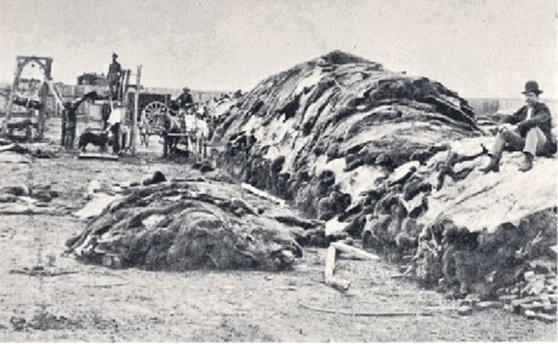
Buffalo hides

Buffalo skulls

The mass buffalo slaughter also seriously harmed the ecological health of the Great Plains region, in which many Indigenous people lived. Unlike cattle, bison were naturally fit to thrive in the Great Plains environment and to survive harsh winters. More importantly, the bison are a keystone species of the prairies and whose grazing patterns and other activities are critical to its cultivation while also supporting a wide range of plants and animals. Some examples include seed dispersal of various plants and shrubs, habitat creation for birds, amphibians and small animals, and facilitating the grazing opportunities of other ungulates such as bighorn sheep, pronghorn antelope, and elk.

Bison were also critical to the survival of their predators, primarily wolves and grizzly bears. Cattle, on the other hand, eat through vegetation and limit the ecosystem's ability to support a diverse range of species. Research also suggests that the absence of native grasses has lead to topsoil erosion and was a main contributor of the dust bowl and black blizzards of the 1930s. Since the onset of the buffalo slaughter the plains region has lost nearly one-third of its prime topsoil.


By the end of the 19th century three important animal species had been made practically extinct in Canada. The beaver, the sea otter, and the bison, with the west coast salmon and east coast cod to soon follow.


In 1867, there were three options for British Columbia to consider. The first was to continue as a British colony (now that Vancouver Island and the mainland were one colony) the second was to be annexed by the United States, and the third was to join the Confederation of the newly formed Dominion of Canada.

Remaining a colony only appealed to the people living on Vancouver Island, as many of them had postings with the Imperial government which would be lost but, for those living on the mainland, the promise of new commercial opportunities and representative government was much more attractive. Furthermore, Britain was keen to divest itself of the colony and any associated military responsibilities. 

Financially it made sense to become part of the United States since it provided all of the colony’s supplies and British Columbia was essentially a satellite of San Francisco and after the American purchase of Alaska in 1867 there was added pressure to incorporate British Columbia into the United States as well.

But British Columbia was in an economic slump after the collapse of the gold rushes and had also accumulated a massive debt which made it less attractive to the Americans. In the end, British Columbia decided to join Confederation on July 20th, 1871 and, in return, Canada absorbed all of its debt, guaranteed pensions to those officials who would lose their jobs, and promised to build a railway from Montreal to the Pacific coast within 10 years.


Endless Warfare Part 3 (1819-1924)


In the United States the Indian Wars to the East of the Mississippi were slowly coming to an end, particularly after the death of Tecumseh which marked the end of the battle for control of the Old Northwest.  As the country continued to expand to the West it kept pushing the remaining Indians further and further from their traditional lands in order to make room for settlers. In 1818 Florida was ceded to the U.S. from Spain and this precipitated the Seminole Wars which lasted until 1842 when all of these people were forcibly removed to make room for settlers.

The Indian Removal Act was signed into law in 1830, by United States President Andrew Jackson. The law authorized the president to negotiate with Native American tribes to surrender their ancestral lands for white settlement in exchange for their removal to federal territory west of the Mississippi River. The Act was strongly supported by southern and northwestern settler populations, but of course opposed by Native tribes who didn’t want to give up their cultivated farmland.

In the end 60,000 members of the Cherokee, Creek, Seminole, Chickasaw, and Choctaw nations were forcibly removed by the United States government in a march to an area in the west that had been designated Indian Territory and later became part of Oklahoma. This forced march became known as the Trail of Tears because of the thousands who died from exposure, disease and starvation in the process before reaching their destination.

Tribes from the Great Lakes and Northeastern Woodlands (the Old Northwest) including members of the Western Lake Confederacy (Shawnee, Delaware, Miami, Kickapoo, Iowa, Sac, Fox, and Potawatomi) and the Council of Three Fires (Ojibwe, Odawa, and Potawatomi) were also moved to the Indian Territory.

By 1842 most of the Indian Wars east of the Mississippi had been settled but, for the next 100 years, the conflicts would be west of the Mississippi and last from 1811-1924. 


In 1861 the American Civil War (1861-1865) broke out over slavery. While slavery had always existed in British North America it had been abolished in Upper Canada in 1793 and in 1834 Britain had abolished it throughout the Empire, freeing 800,000 slaves, mostly in the Caribbean.

In the U.S. the war was between the Union states that remained loyal to the federal union, or “the North” and the Confederacy states that voted to secede, or “the South”. The central cause of the war was the status of slavery, especially the expansion of slavery into territories acquired as a result of the Louisiana Purchase and the Mexican-Amercian War. On the eve of the Civil War in 1860, four million of the 32 million Americans were enslaved black people, almost all of them living in the South. 

Slavery was the central source of escalating political tension in the 1850's. The Republican Party was determined to prevent any spread of slavery to the territories, which, after they were admitted as states, would give the South greater representation in Congress and in the Electoral College. Many Southern leaders had threatened secession if the Republican candidate, Lincoln, won the 1860 election. After Lincoln won, many Southern leaders felt that disunion was their only option, fearing that the loss of representation would hamper their ability to promote pro-slavery acts and policies.

Slavery was the main cause of disunion. Slavery had been a controversial issue during the framing of the Constitution but had been left unsettled. The issue of slavery had confounded the nation since its inception, and increasingly separated the United States into a slaveholding South and a free North. The issue was exacerbated by the rapid territorial expansion of the country, which repeatedly brought to the fore the issue of whether each new territory should be slaveholding or free. The issue had dominated politics for decades leading up to the war.

Confederate soldiers fought the war primarily to protect a Southern society of which slavery was an integral part. From the anti-slavery perspective, the issue was primarily whether slavery was an anachronistic evil incompatible with republicanism. The strategy of the anti-slavery forces was containment, to stop the expansion of slavery and thereby put it on a path to ultimate extinction. The slaveholding interests in the South denounced this strategy as infringing upon their constitutional rights. Southern whites believed that the emancipation of slaves would destroy the South's economy, due to the large amount of capital invested in slaves and fears of integrating the ex-slave black population. 

Manifest destiny heightened the conflict over slavery, as each new territory acquired had to face the thorny question of whether to allow or disallow slavery. Between 1803 and 1854, the United States achieved a vast expansion of territory through purchase, negotiation, and conquest. At first, the new states carved out of these territories entering the union were apportioned equally between slave and free states but pro and anti-slavery forces collided over the territories west of the Mississippi.

The Mexican-American War and its aftermath was a key territorial event in the lead-up to the war. The 1848 Treaty of Guadalupe Hidalgo finalized the conquest of northern Mexico west to California and slaveholding interests looked forward to expanding into these lands.

During 1861–1862 in the war's Western Theatre, the Union made significant permanent gains but in the war's Eastern Theatre the conflict was inconclusive. On January 1, 1863, Lincoln issued the Emancipation Proclamation, which made ending slavery a war goal, declaring all persons held as slaves in states in rebellion "forever free."

To the west, the Union destroyed the Confederate navy by the summer of 1862, then much of its western armies, and seized New Orleans. The successful 1863 Union siege of Vicksburg split the Confederacy in two at the Mississippi River. In 1863, Confederate General Robert E. Lee's incursion north ended at the Battle of Gettysburg. Western successes led to General Ulysses S. Grant's command of all Union armies in 1864.

Inflicting an ever-tightening naval blockade of Confederate ports, the Union marshaled resources and manpower to attack the Confederacy from all directions. This led to the fall of Atlanta in 1864 to Union General William Tecumseh Sherman and his march to the sea. The last significant battles raged around the ten-month Siege of Petersburg, gateway to the Confederate capital of Richmond.

The Civil War effectively ended on April 9, 1865, when Confederate General Lee surrendered to Union General Grant at the Battle of Appomattox Court House, after having abandoned Petersburg and Richmond. Confederate generals throughout the Confederate army followed suit.

By the end of the war, much of the South's infrastructure was destroyed, especially its railroads. The Confederacy collapsed, slavery was abolished, and four million enslaved black people were freed. The war-torn nation then entered the Reconstruction era in a partially successful attempt to rebuild the country and grant civil rights to freed slaves.


As American settlers and fur trappers first spread into the western United States territories, they established various trails leading from Missouri. These included the Santa Fe Trail, the Oregon Trail, the Mormon Trail, the California Trail and later the Bozeman Trail.

Initially relations were generally peaceful between American settlers and Indians but, as the combination of various gold rushes, the end of the Mexican-American War (1848) the U.S. Homestead Act (1862) and the Civil War (1865) brought more and more settlers and miners into the Great Plains and Rocky Mountains, conflicts over the land and resources led to warfare. 

During the Amercian Civil War, Army units were withdrawn to fight the war in the East. They were replaced by the volunteer infantry and cavalry raised by the states of California and Oregon, western territorial governments, and local militias. These units fought the Indians (who mostly sided with the Confederacy) and kept open communications with the east, holding the West for the Union and defeating the Confederate attempt to capture the New Mexico Territory.


Many tribes fought the American settlers, and between 1811-1924 there were hundreds of battles between the settlers and soldiers, and various Indian Nations, with thousands dying in the process. In Texas it was with the Cherokees and Comanches, in the Pacific Northwest it was with the Yakama and Cayuse, and the Rogue River people. In the Southwest it was with the Navajo and Apache and in the Great Basin it was with the Utes and Nez Perce. In California, Oregon & Nevada it was with the Shoshone and other members of the Snake Indian confederacy, and in Colorado and Nebraska it was with the Cheyanne.

But it was the Sioux of the Northern Plains and the Apache of the Southwest that waged the most aggressive warfare, led by resolute, militant leaders such as Red Cloud and Crazy Horse. The Sioux were relatively new arrivals on the Plains, as they had been sedentary farmers in the Great Lakes region previously. They moved west, displacing other Indian tribes and becoming feared warriors.

After the Civil War ended in 1865, national policy called for all Indians to either assimilate into the American population as citizens, or to live peacefully on reservations. Raids and wars between tribes were not allowed, and armed Indian bands off a reservation were the responsibility of the Army to round up and return.


Nonetheless the Great Sioux War erupted in 1876-1877 (also known as the Black Hills War) and was a series of battles and negotiations that occurred between an alliance of Lakota Sioux and Northern Cheyenne against the United States and was conducted by the Lakota Sioux under Sitting Bull and Crazy Horse. The cause of the war was the desire of the US government to obtain ownership of the Black Hills which was Indian territory. The conflict began after repeated violations of the 1868 Treaty of Fort Laramie once gold was discovered in the Black Hills. As settlers began to encroach onto Native American lands, the Sioux and the Cheyenne refused to cede ownership. 

One of its famous battles was the 1876 Battle of the Little Bighorn, in which combined Sioux and Cheyenne forces defeated the 7th Cavalry, led by General George Armstrong Custer. Often known as Custer's Last Stand, it is the most storied of the many encounters between the US Army and mounted Plains Indians. Despite the Indian victory, the Army regrouped and began a campaign of  attacking and destroying Indian encampments and property, which ended with the Wounded Knee massacre in 1890 and their surrender. 

After the Battle of the Little Bighorn, Sitting Bull left the United States in 1877 and crossed into Canada with his band. Here he met up with Crowfoot and Big Bear who he tried to persuade in joining him in his war with the American army and the R.C.M.P. They both turned him down. However, with the diminished bison herds, he couldn't find enough food to feed his people and it created tensions with the Canadian government who refused to give him and his people a reserve. After four years he returned to the U.S. where he was assigned a reservation to live following his surrender.


Sitting Bull

By 1890, settlement in the American West had reached sufficient population density that the frontier line had disappeared and the Census Bureau released a bulletin declaring the closing of the frontier as there was no longer a clear line of advancing settlement. The West was won and the Indians were now all on reservations and/or facing assimilation. Nonetheless, following the surrender of Geronimo in 1886, the Apache wars continued until 1924 which was the last raid into U.S. territory by a group of Apache warriors into Arizona.


Canadian Reserves


After nearly 300 years of continuous conflict in North America, from the start of the Beaver wars in 1610, the settlers and colonists had finally won. 40,000 years of Indigenous history, culture and way of life was mostly extinguished and almost all of their land was taken away. While the slaughter was much greater in the U.S., where the remaining people ended up on reservations, in Canada they were put on reserves, but the end result was the same. 


American Reservations

The amount of land set aside as reserves for the First Nations amounts to less than 0.4% of the total Canadian landmass. The combined landmass of all the First Nations reserves in Canada is less than half the landmass of the Navaho Reservation in the U.S. But, while there are basically no reservations east of the Mississippi, the Canadian reserves are spread across the entire country.


New Developments On The North And West Coasts (1824-1864)


Europeans had been searching for a shortcut to Asia from Europe by sea since the 15th century. By the mid-19th century numerous exploratory expeditions had been mounted, with most of them led by Britain. These voyages, when successful, added to the sum of European geographic knowledge about the Western Hemisphere, particularly North America. As that knowledge grew, exploration gradually shifted towards the Arctic.

16th and 17th century voyagers who made geographic discoveries about North America included Martin Frobisher, John Davis, Henry Hudson and William Baffin. The establishment of the Hudson's Bay Company and the Northwest company led to further exploration of the Canadian coastlines, its interior and the adjacent Arctic seas. In the 18th century, explorers of this region included Henry Kelsey, James Knight, Pierre La Verendrye, Anthony Henday, Christopher Middleton, Samuel Hearne, James Cook, Alexander Mackenzie, Simon Fraser, David Thompson, and George Vancouver. By the beginning of the 19th century their discoveries had conclusively proven that no Northwest Passage between the Pacific and Atlantic Oceans existed on either the west or east coast.

In 1804, Sir John Barrow, who became Second Secretary of the Admiralty, began pushing for the Royal Navy to find a Northwest Passage over the top of Canada. Over the next 40 years he organized a series of expeditions towards the North Pole by explorers that included John Ross, David Buchan, William Edward Parry, Frederick William Beechey, James Clark Ross, George Back, Peter Warren Dease, and Thomas Simpson.  Among those explorers was John Franklin, who had led a disastrous overland expedition along the Canadian Arctic coast, in 1819–22 and a more successful one with John Richardson in 1825–27.

By 1845 the combined discoveries of all these expeditions had reduced the unknown parts of the Canadian Arctic that might contain a Northwest Passage to an area of about 70,000 sq miles. It was into this unexplored area that the next expedition was to sail, heading west through Lancaster Sound, then west and south, however ice, land and other obstacles might allow, with the goal of finding a Northwest Passage. The distance to be navigated was roughly 1,040 miles.

Franklin was assigned to traverse the last un-navigated sections of the Northwest Passage in the Canadian Arctic and, in 1845, he set out with two ships, Erebus and Terror. Unfortunately, he met with disaster when his ships became icebound near King William Island/Victoria Strait and all crew members eventually perished. It would take until 1906 when Roald Amundsen was able to complete the journey that the Northwest Passage would finally be discovered.


In the meantime, however, after not hearing any news from Franklin, the British Admiralty decided in 1848 to start a search, and a series of various private and public expeditions were launched over the next 6 years, along with considerable reward money, in an effort to either assist the Franklin crew or locate their remains. They all failed, but eventually it would be another intrepid HBC employee, John Rae, who, in 1854, would solve the mystery of the failed expedition. Rae was considered a pioneer in Arctic travel because he learned the ways of the Inuit to live off the land and use snowshoes, sleds and igloos to get around and survive. By going overland from Churchill, as part of a survey mission up the west coast of Hudson Bay, and then across the Boothia peninsula to King William Island he met up with the local Inuit who told him how the crew had died of scurvy and starvation in spite of practising cannibalism, and sold him some items that had belonged to the crew members, including a telescope, a silver plate and some cutlery. While Rae eventually collected the reward money for the Franklin discovery he never got the reward for discovering the Northwest Passage as well. As a result of this expedition, and his three earlier ones along the north coast, he had ended up discovering the Northwest Passage, but was denied the reward, and credit for the discovery was given instead to Commander Robert McClure, a member of another failed Franklin search expedition. 


While all the exploration of the North was going on, fur trade competition between Russia, various U.S. merchants, and the HBC was in full swing on the west coast. Russia controlled most of the coast of what is now Alaska and they also tried to expand further south to the 45:50 latitude but, in 1824, they settled with the U.S. that their territory would end at the 54:40 latitude. South of Alaska, however, the coast was open to free trade and there was fierce competition between HBC and the Americans. The headquarters of HBC was Fort Vancouver, built in 1824 on the Columbia River at the junction of the Williamette River.


Fort Vancouver

To strengthen its coastal trade and drive away the American traders HBC built a series of fortified trading posts between the Alaska border and the Columbia River. Fort Langley was the first, established in 1827 on the Fraser River about 50 km from the river's mouth. The next was Fort Simpson, founded in 1831 at the mouth of the Nass River followed by Fort McLoughlin (1833), Fort Stikine (1840), Fort Durham (1840), and Fort Victoria (1843). However, by 1841 with the sea otter basically extinct, the American traders abandoned the North West Coast, and the west coast fur trade competition was over.


Under the banner of Manifest Destiny, successive American presidents continued to push for more and more territory in the North American continent so the U.S. could extend from the Atlantic to the Pacific. By the mid 19
th century, everything had been either purchased, annexed, or ceded with the exception of the Oregon Territory.

In 1846 the Oregon Treaty extended the border between Britain and the U.S. along the 49th parallel from the Rockies to the Pacific ceding Oregon Country to the U.S. but giving all of Vancouver Island to Britain. With Fort Vancouver now in American territory it was no longer profitable or practical to operate so HBC closed it down and moved its operations to Fort Victoria. In 1849 Vancouver Island and the surrounding Gulf Islands were made into a colony and put under the administration of HBC and the Governor James Douglas. 

In 1856 gold was discovered in the Thompson River by the Shuswap (Secwepemc) nation. The presence of gold was kept secret until a sample of 800 ounces was sent to San Francisco in 1857. When newspapers picked up the story it sparked the Fraser Canyon Gold Rush and thousands of prospectors from the U.S. started arriving in the New Caledonia and Columbia trading districts.

James Douglas, the HBC Governor, who had no legal authority over New Caledonia or Columbia, nonetheless stationed a gunboat at the entrance of the Fraser River and collected licences from prospectors attempting to make their way upstream. To normalize its jurisdiction, and undercut any HBC claims to the resource wealth of the mainland, the districts were converted to a Crown colony in 1858 by Britain and given the name British Columbia.

Douglas was offered the governorship of the new colony, in addition to Vancouver Island, on the condition he sever his relationship with the HBC. Douglas accepted these conditions, and was given a knighthood.

The ongoing Indian Wars in the United States heightened American animosity towards First Nations people and even though they were in British territory they carried with them all their prejudices. In the fall of 1858, escalating tensions between the miners and the Nlaka’pamux people of the central area of the canyon broke out into the Fraser Canyon War.

The war was precipitated when a young Nlaka'pamux woman was raped by a group of American miners, in the area of Kanaka Bar. The Nlaka'pamux retaliated by killing several of them, decapitating the bodies, and dumping them into the river. They were eventually found circling in a large eddy near the town of Yale, the main commercial centre of the rush, and this alarmed the thousands of miners lining the riverbanks between Yale and Kanaka Bar.

For some time in the months leading up to this incident, tensions had risen due to increasing conflict between Indigenous people and the encroaching miners. In particular the local First Nations were upset about the destruction of the salmon run and the salmon spawning habitat, owing to the miner's destructive placer mining techniques and use of mercury. They were also upset at being displaced by the mostly American miners who gave no thought to their established settlements and thought they could simply move the First Nations people out of the way like they were accustomed to doing in the U.S. Both sides begain raiding each other's camps which led to more bloodshed and death.

Due to the reputation of the Nlaka'pamux, the riverbanks north of Yale were emptied, as miners in the thousands fled south to the relative safety of Spuzzum and Yale. There the miners held meetings and six regiments of mostly Americans were hastily organized. At Camchin, the ancient Nlaka'pamux "capital" at the confluence of the Fraser and Thompson Rivers, the assembled leaders of the Nlaka'pamux and allies from the Shuswap and Okanagan peoples also held council. Both sides had leaders that wanted to wipe each other out completely but, in the end, peace was agreed thanks to the good relations Chief Cxpentlum had with Governor James Douglas and the moderating influence of Harry Snyder, one of the American leaders.


Barkerville

The Fraser Canyon Gold Rush was short lived but, in 1862, the Cariboo Gold Rush began and it was much bigger, with many towns being developed including Barkerville, the most famous.

Unlike the Fraser Canyon, the mining population of the Cariboo Gold Rush was largely British and Canadian, including 4,000 who were Chinese. The absence of Americans was probably due to the fact the Civil War had started. By the time the Cariboo Rush broke out there was more active interest in the Gold Colony (as British Columbia was often referred to) in the United Kingdom and Canada and there had also been time for more British and Canadians to get there.

Continuing his service as Governor, Douglas ordered the construction of the Cariboo Wagon Road. Designed to replace the original Wagon Road which was a combination of wagon roadway and lake paddlewheelers that ran via Harrison, Lilloet, Anderson, and Seton Lakes, this engineering feat ran 400 miles from Fort Yale to Barkerville through extremely hazardous canyon territory. The Cariboo Wagon Road was also called the "Queen's Highway" and the "Great North Road" and its first version was completed in 1862.


In 1864 there was another bad run-in with Europeans and First Nations in the B.C. interior and it became known as the Chilcotin War. The dispute started in 1864 when a road crew entered Tsilhqot'in territory, without permission, to construct a road up from Bute Inlet, and it escalated into grievances over unpaid wages, working conditions, and lack of food. More importantly, the Tsilhqot'in  believed they were being deliberately infected with smallpox in order to take over their land (a suspicion that was validated following the 1862 epidemic that killed thousands and was later admitted to by agents of the company that they were using infected blankets to spread the disease). The Tsilhqot'in declared themselves at war and vowed to expel all settlers until satisfactory arrangements could be made with the Crown. Britain had only recently, because of the Fraser Canyon gold rush, created the colony of British Columbia in 1858, and no officials had yet met with the Tsilhqot'in who still considered themselves a sovereign people. 

Initially 14 men working for the company on the road crew were killed but another four settlers were later killed as well. The new Governor of the Colony of B.C. Frederick Seymour then raised three militias to invade the territory and capture the leaders. These forces threatened the Tsilhqot'in with extermination and burned their homes and fishing camps in an attempt to get them to give up their leaders. Another settler leader was also killed before a peace conference was arranged with the promise of immunity for all who attended. A party of 8 Tsilhqot'in leaders arrived at the conference and were promptly ambushed and taken into custody. At a trial held in Quesnel, five were found guilty of murder, even though they argued they were waging war between sovereign nations, and were hanged on October 26, 1864. A 6th leader was later tried and hanged as well.

In 2014 the B.C. government exonerated the 6 leaders for any crime or wrong doing and in 2018 the Federal government also exonerated them and made a formal apology. October 26th is a now a national holiday of remembrance amongst the Tsilhqot'in. 

The Chilcotin War might have been avoided if James Douglas was still in office but in 1864 he had just retired. His relations with First Nations peoples were mixed. On the one hand, Douglas' wife was Cree, he had established many close business and personal relationships with Indigenous peoples as a fur trader, he sought to conclude modest treaties (the Douglas Treaties) with First Nations on southern Vancouver Island, and he helped them initially secure large areas of reserved land. On the other hand, Douglas supplied Washington Territory's Governor Isaac Stevens with arms and other supplies to assist the US government in its conflict with Native American tribes.

Governor James Douglas